

Why Every Muslim in the UK Needs a Will — and Why Wishing Isn’t Enough
An educational article for the Muslim community in England & Wales

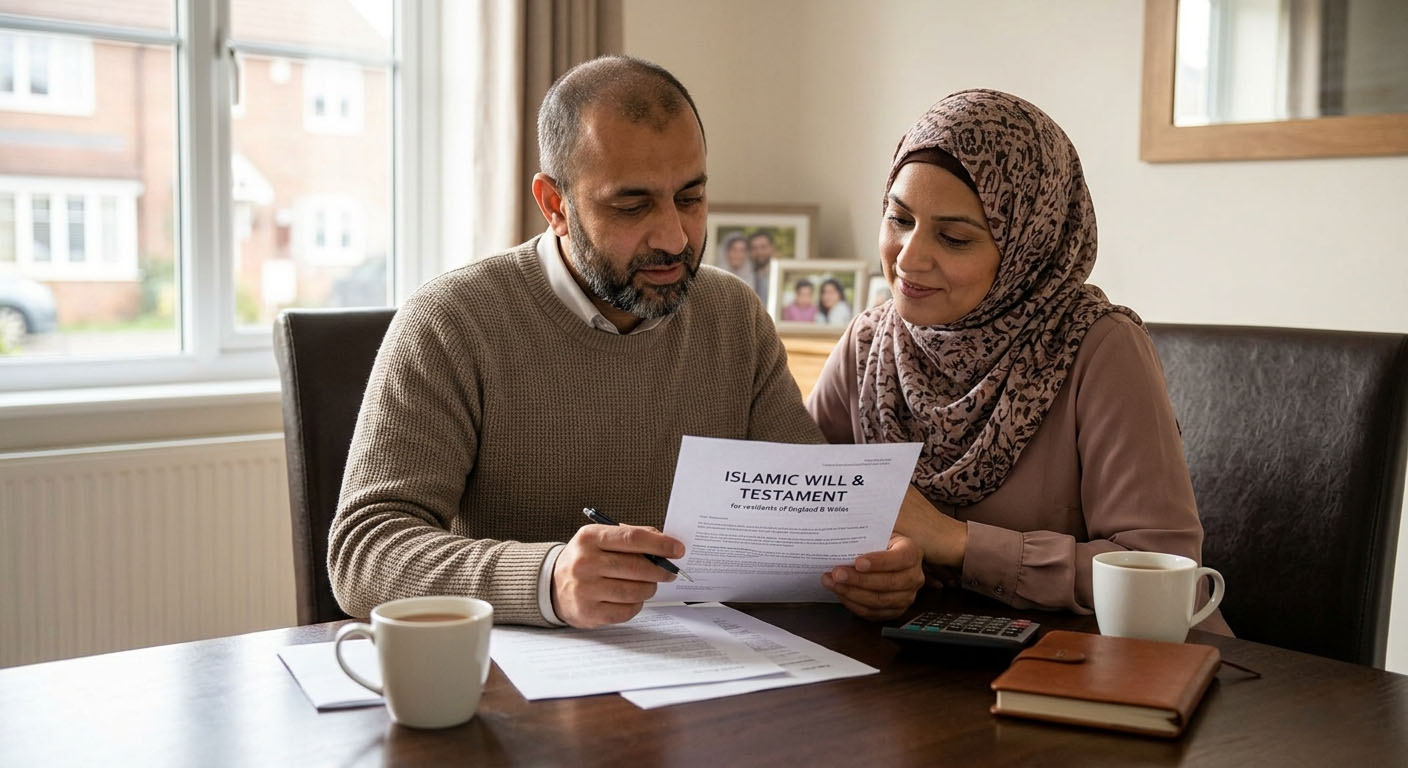
Most of us know, somewhere in the back of our minds, that we should have a will. We mean to sort it out. We tell ourselves we’ll do it soon — after Ramadan, after the house move, after the children are a bit older.
But for Muslims living in England and Wales, leaving it undone isn’t just a practical risk. It is, according to a hadith recorded in Sahih al-Bukhari and Sahih Muslim, something a Muslim should not delay.
The Prophet ﷺ is reported to have said: “It is not permissible for any Muslim who has something to bequeath to sleep for two nights without having his last will and testament written and kept ready with him.” (Bukhari 2738; Muslim 1627)
That’s a striking statement. Not “advisable.” Not “a good idea.” The language is deliberate. Scholars across the madhabs have interpreted the writing of a will as at minimum strongly recommended — and in circumstances where family members could otherwise be wronged, as obligatory.
So why do so many of us still not have one?
What Is a Wasiyyah?
A wasiyyah (وصية) is an Islamic will — a legal document in which a Muslim expresses their final wishes regarding their estate, charitable bequests, and the care of dependants after death.
Under Islamic inheritance principles, a person may bequeath up to one-third of their estate to whomever they choose — including causes, charities, or individuals who would not otherwise inherit under the fixed shares. The remaining two-thirds is distributed according to faraid (فرائض) — the fixed inheritance shares ordained in the Quran (see Quran 4:11–12 and 4:176) — and generally cannot be redirected by the wasiyyah.
The wasiyyah is therefore not a mechanism for overriding Islamic inheritance law. It is a complement to it: the portion of your estate where your personal intentions are expressed — a final sadaqah jariyah, a gift to a cause you loved, a bequest to a grandchild not covered by faraid.
Why English Law Matters Too
Here is the part many Muslims in the UK don’t fully appreciate: Islamic principles alone do not govern what happens to your estate in England and Wales.
English law operates under its own inheritance framework. If you die without a valid English will — what lawyers call dying intestate — the Intestacy Rules under the Administration of Estates Act 1925 determine exactly who receives what. Those rules follow a fixed legal order of priority: spouse, then children, then more distant relatives. They do not follow faraid. They make no provision for wasiyyah. And they cannot be overridden by what your family believes your wishes were.
This means that a Muslim who dies without a valid English will may have their estate distributed in a way that is:
- Out of step with faraid — because English intestacy rules do not mirror Islamic inheritance shares
- Incapable of capturing their wasiyyah — because bequests require a valid will to be enforceable
- Silent on guardianship — because without a will, courts decide who cares for your young children
A handwritten note, a verbal instruction to family, or a document that was never properly witnessed cannot fix this. Under English law, a will that isn’t correctly signed and witnessed simply does not exist.
The Dual Obligation
Muslims living in England and Wales carry what you might think of as a dual obligation:
Islamically, the tradition of wasiyyah is one of the most clearly attested practices in the Sunnah. Umar ibn al-Khattab (رضي الله عنه) reportedly said that a Muslim should not let a night pass without their will being documented. The scholars of fiqh — across Hanafi, Maliki, Shafi’i, and Hanbali schools — are largely agreed that writing a will is at minimum strongly recommended, and in many personal circumstances, obligatory.
Legally, English law requires a valid will to give effect to any of those wishes. Without it, the state steps in with its own rulebook — one written with no knowledge of or regard for Islamic principles.
The good news is that both obligations can be satisfied with a single document. An Islamic will written under English law — one that reflects faraid shares, captures your wasiyyah up to one-third, names a guardian for your children, and appoints a trusted executor (known in Islamic tradition as a wasi) — is both spiritually sound and legally binding.
What Should an Islamic Will Cover?
A properly constructed Islamic will for someone living in England and Wales should typically address:
- Distribution according to faraid The will can state explicitly that the estate is to be distributed in accordance with Islamic inheritance principles. This gives your executor a clear mandate and reduces the risk of family disputes.
- The wasiyyah — up to one-third This is where you direct the discretionary portion of your estate. Common choices include a bequest to a favourite charity, a mosque, a cause you supported in life, or a relative who would not otherwise inherit under faraid (such as a grandchild whose parent is still living).
- Appointment of a wasi (executor) Your executor manages the process of administering your estate. Under English law, they are legally responsible for gathering assets, paying debts, and distributing the estate. Choosing someone you trust, who understands both the legal process and the Islamic principles at play, matters enormously.
- Guardianship for children If you have children under 18, your will is the place to name who you wish to care for them. Courts are not bound by your wishes, but they give them significant weight. Leaving this blank is leaving a major decision to someone who doesn’t know your family.
- Burial wishes While not strictly part of your legal estate, a will is often the only document consulted in the immediate aftermath of death. Including your preference for Islamic burial rites — prompt burial, no post-mortem where avoidable — ensures your wishes are on record.
A Common Misconception: “My Family Knows What I Want”
The most frequently heard reason for not having a will is some version of: “My family knows what I want — they’ll sort it out.”
This is understandable. It is also, unfortunately, not how English law works.
If there is no valid will, your family cannot simply agree among themselves to distribute the estate according to faraid. They may try — and in many cases, families do reach informal agreements — but those agreements have no legal standing. Banks will freeze accounts. Probate courts will apply intestacy rules. And if there is any disagreement among family members (which bereavement, even in loving families, can bring out), the law will not recognise what you intended.
A will changes that. It gives your intentions legal force.
The Barrier Is Usually Practical, Not Principled
Very few Muslims would argue that they don’t want to fulfil this obligation. The barrier is almost always practical: not knowing how to start, worrying it will be expensive, feeling uncertain about how faraid works in an English legal context, or simply putting it off.
These are all solvable problems.
For Muslims in England and Wales, platforms like WillsConnect are specifically built to handle the intersection of Islamic inheritance principles and English law — walking you through the process of creating a will that is both shariah-aware and legally valid, with the option of solicitor review for more complex estates. The guided process takes most people under an hour.
The Prophet ﷺ did not say it should be difficult. He said it should not be delayed.
A Final Thought
Writing your will is an act of care for the people you love. It is also, for Muslims, an act of obedience — a recognition that what we leave behind should reflect the values we lived by.
The wasiyyah is not a morbid document. It is a final expression of faith, responsibility, and generosity. It is the last gift you give your family: clarity, when they need it most.
Don’t leave it another night.
This article is for educational purposes and does not constitute legal or religious advice. For personalised guidance, consult a qualified solicitor or Islamic scholar.
Tags: Islamic will, wasiyyah, faraid, Muslim inheritance UK, Islamic wills England, wills for Muslims, Islamic estate planning


